Friday, January 04, 2008

The Northern Lights / The Golden Compass

Last month I listened to the unabridged audio book of 'The Northern Lights' by Philip Pullman. Last night I went to the cinema and saw the movie 'The Golden Compass' based on that book. Here are my thoughts on both...

Much has already been said on the subject of the anti-religious message in the book(s) and how this has been played down (or dumbed down) for the film, but if you actually consider 'The Northern Lights' by itself, without reference to either of the books that follow, the message is not as clear or as anti-religious as some believe. Certainly, in the book, the Magisterium (i.e. the church) is portrayed as being a sinister, corrupt and possibly evil organisation. Similarly, in the film, the Magisterium are clearly made out to be the 'bad guys', although here the picture is painted in much broader brush strokes. But neither the book or the film goes as far as to suggest that there is any spiritual power behind the Magisterium, it could simply be an entirely man-made organisation. Of course, if you've read the other books, you'll know that 'The Authority' (i.e. God) is a character with a part to play, but that is not clear in the first book or film.

Possibly the greatest achievement of the book is the concept of 'deamons', the animal-like personifications of the souls - and constant companions - of every human in Lyra's world. At the start of the book the concept is completely alien to the reader (or, in my case, listener) but Pullman conveys the concept so well that by the middle of the book the reader is truly shocked by the idea of separating the human from their deamon, so the experiments at Bolvangar seem really horrific. In the film the deamon concept is also handled well and must have been a nightmare for the animators. Perhaps the film should have emphasised the idea that humans and their deamons can't be separated by more than a few metres and that there is physical pain if this is extended. Also, the horror of the chamber in Bolvangar is lost in the film because no real explanation is given, there is no warning of what might happen, and it all happens so quickly that the importance of the scene is lost. Indeed, that scene is probably the film's greatest failing.

Dust. The book and the film are all about dust. In the book, dust is something mysterious that Lyra is keen to find out about. In the film there isn't half the mystery about it and it is more just taken as being part of the world, but isn't really very interesting. One of the key things about dust in the book is omitted from the film (though may be at the start of the next one, I suppose) when Lyra and Pan discuss dust and decide that if the Magisterium and Mrs Coulter, etc. think that dust is bad, maybe it's actually good... But what dust actually is is not revealed in either the book or the film - its one of the mysteries that we hope will be revealed in future bits of the story.

One of my favourite things about The Northern Lights was the concept of 'ambaric' power. This is mentioned several times but never explained in the book. Although (slight spoiler here) I was really disappointed by the discovery in the third book that ambaric and electric power were just the same thing, it would have been cool if they had turned out to have been different somehow. In the film, however, although it is never named, various things (airships, carriages, etc.) are apparently powered by cool, blue, gyroscopic machines, which I assume to be an imagining of ambaric power. Nice touch.

One of the oddest decisions in the film was to change the sequence of events from that in the book. I was surprised that the re-ordered sequence of events worked quite well. Thus the big fight at Bolvangar was moved to the end of the film, rather than the end of the middle section of the book, and the bear fight was moved earlier in the film rather than being towards the end of the book. The only thing contrived about the change in order was the explanation (or lack thereof) of why the raiders should have taken Lyra to the bear king as a gift. In the book it makes sense that they take her to Bolvangar, but taking her to the bears makes no sense.

In summary, the book is a great read full of action and big concepts which are thought provoking and interesting. The film dispenses with much of the subtlety in the book and makes everyone clearly good or bad (except Lord Asriel, who remains ambiguous), but is a surprisingly faithful adaptation (faithful to the spirit of the book, if not the chronology), which is gloriously realised and reasonably gripping. I'd recommend both.

However, in my opinion, the second book is not as good as the first and the third is disappointing, so we'll see what happens with the next two films...


By the way, I think the book(s) would have been better adapted into a TV series or mini-series, as the books are quite episodic in nature, but I guess that hasn't happened. Also, I really do recommend the audiobook versions of the books. They're read by the author himself, but all the dialogue is performed by actors, so it feels more like a radio play than a talking book. Very nice.


Labels: , , ,

Friday, December 21, 2007

The Fountain

Huh?

This film didn't really grab me. For most of it, indeed, for all of it, I wasn't sure what was going on. Something to do with life and death. Trying to be arty. Not really succeeding.

Looks like the secret of living forever is to die and plant a tree above your coffin. Or something like that anyway.

Not recommended.

Labels: , , ,

Tuesday, December 18, 2007

The Cavalcade of Bad Nativities


This page is fantastic in its awfulness: The Cavalcade of Bad Nativities. Just browse... and groan.

Labels: , ,

Thursday, August 02, 2007

The Golden Compass

How good does the Golden Compass look? If you haven't seen the trailer (or even better, the 'Comic Con' clip compilation) head over to the official site [www.goldencompassmovie.com] and watch it now. Fantastic.
The only problem I have with this is that 'The Northern Lights' (the UK title of the book that this film is based on) is by far the best and most interesting book in the trilogy ('His Dark Materials' by Philip Pullman). So this movie will be followed by two others that are not quite as good as it. Also, rumour has it, the film plays down the anti-religion message of the books, which I can see is quite easy in the first movie, but how can you do the third one without it - its the very heart of the book?

Labels: , , ,

Monday, April 16, 2007

Machrie Moor

For the first fifteen years of my life I spent part of my Easter and summer holidays in Arran - staying with my Mum's Aunt May (my maternal grandfather's elder sister). In all those holidays I got to know (and love) much of the north part of Arran; Lochranza, Catacol, Pirnmill, Sannox, Corrie and as far down the east coast as Brodick, Lamlash and Whiting Bay. After Aunt May died (in 1985) we never went back to Arran. I have always meant to go back, but never quite made it. Until last week.

We had three days in Arran last week, in glorious sunshine. Nearly 22 years since the last time I had been there I did a whistle-stop tour of many of the places I remember from my childhood. Few of them have changed.

But I also had the chance to go to a few places that I had never been to before. I don't know why, but I had never been to Machrie Moor before, despite being quite interested in stone circles and the like. So I went and was very impressed.

I did a tour of all the stone circles on Mull a few years ago, and they were interesting, but nothing like as good as Machrie. The sheer quantity of prehistoric stone circles at Machrie is astounding. And some of the larger stones are still standing after 5000+ years.

All this by means of introduction... here are three of my photos:
This photo doesn't convey the size of the stone. If I was standing next to it, I wouldn't be half the height of it.

There are five stone 'circles' in this field. And archaeologists have uncovered evidence of others and several timber circles which predate them.

Once again, this photo doesn't convey the size of these. Suffice it to say that they're big and impressive.

Labels: , , ,

Thursday, March 01, 2007

Everyone has a book inside of them...

According to a Readers' Digest survey a few years ago, over 70% of people believe that 'everyone has a book inside of them'. Some years ago I had a conversation with a few friends (at least one of whom reads this blog; hello San) where we discussed this and I admitted that I had the bones of a story in my head. The story in question was a Narnia-like kids fantasy story and, when questioned about it I made the mistake of replying that 'my fantasy world isn't fully developed' - which resulted in a good few sniggers.

Anyway, the fantasy world has actually developed over the years and I now have a much more fully thought through novel idea. What I don't seem to have found is the time to actually put pen to paper (or, more likely, fingers to keyboard) and actually write the thing. In a moment of extreme procrastination a few years ago, when I was supposed to be writing my PhD thesis, I actually did write the entire prologue and first chapter of that book, but never wrote any more. If I was to revisit it, I would almost certainly rewrite the entire thing from scratch.

Over the past few years, two other story ideas have formed in my head, although neither has been written in any form, and I'm not sure I am actually capable of doing the ideas justice. But since this blog is an airing ground for my private ideas, I thought I'd share the half-baked ideas with you, my somewhat restricted reading public, and see if you want to offer any thoughts or comments on my book ideas...

Story 1
This started out life as being a kids' fantasy, but as the idea has developed it has become much more of a 'young adult' novel, more in line with the tone and subject matter of the later Harry Potter books (which feature death, politics, hatred and snogging) than the Narnia stories. As yet the book has no title. The story follows two characters, the first is an eleven year old boy from Edinburgh who ends up in the fantasy world, the other is a nineteen year old student alchemist from the fantasy world who ends up in our world. The story follows each character, chapter about, as they find out about the world they find themselves in and, as is usual in these sort of stories, find out about themselves along the way. The story is deliberately episodic in nature and does (deliberately) adhere to several of the cliches of fantasy writing. Hopefully I would be able to subvert the cliches in an entertaining manner. The main problem I have with this story is how to keep the story of the alchemist in this world interesting. Most of the action happens in the fantasy world, but I want some to happen here too.

Story 2
This is another fantasy novel. Given that most of the books I read are fantasy, it is no surprise that most of the books I want to write are also fantasy. The idea of this book is a much more complicated one. The entire events of this story occur in a fantasy world, although I don't necessarily think that any magic occurs here. The benefit of setting a story in a fantasy world is that the reader has no presuppositions about what is real there.

In many ways the pattern for this book was inspired by 'The Lions of Al Rassan' by Guy Gavriel Kay - that book is set in a fantasy world, yet there is no magic in the book at all. In that story the main characters are from different religious groups, with different gods, but the reader has no pre-judged idea of whether there is or is not a god - it may be that all the gods are real, it may be that none are, it may be that only one is, but the reader does not know - and it turns out to be irrelevant to the story, but the reader doesn't know that at the outset. When reading a fantasy novel people expect real gods and magic...

Anyway, the concept behind this novel is that it is set in a reasonably small, back-water type town which is part of a larger empire. The town is ruled (or is it?) by a woman considered by some to be royalty, considered by others to be a witch, considered by herself to be something else entirely. Each chapter is told in first-person narrative by a different character in the story. Thus, it is told from within the belief system and presuppositions of that character. All the characters have different viewpoints and perhaps none of them are close to reality. The main point of the story is who is this woman? The final chapter is told from her point of view, so we finally find out (or do we? maybe she is deluded?). This is a tricky story to tell and I'm not sure I have the time or ability to actually do it well. Perhaps when I'm older.

There is a cliche in certain types of fantasy novels relating to maps. See, for example, the stories of David Eddings. Here the maps are important and he seems intent on taking the story through all the different countries and places on the maps that he has devised. My subversion of the map idea here is that each chapter starts with a map; not a map of how the world is, but rather a map of how the world is perceived by the narrator of that particular chapter. For example, the opening chapter is narrated by a young teenage boy, his map shows the town (provisionally named 'Stone') centrally on the map, with very little detail more than a day's journey away from the town. The chapter narrated by the merchant has a much more detailed map of the whole empire, and so on. In fact the whole novel idea more or less sprung from this concept.

Story 3
This is the story which I am actually most likely to work on. It is not a fantasy in the sense of the other two, but is not set in the real world either. It is more of an alternative history. The story is narrated in first person by an old man, writing to a younger audience. I think he is writing in about the year 2050, when he is over 100 years old and is on some form of life-support machine. He is recounting the days of his youth to anybody who has time to listen. The novel begins with a shocking opening line - which was basically the first thing I thought of and the basis for the whole story that unfolds thereafter. The opening line is:
"Although I was only five at the time, I can still clearly remember where I was and what I was doing on the day that God died."
From that opening, the narrator recounts the story of how 'research theologians' in California had conclusively proved the existence of God some years earlier and talks through all the subsequent discoveries they made about the nature of God over the next few years, before inadvertently killing him in 1950. The narrator also recounts the response of the religious and non religious people, first to the revelation that there definitely was a God, then to the revelation that he was dead. The story also recounts the events of world history between 1950 and 2050 in the light of the absence of God. Due to the scatter-brained character of the narrator, all this does not necessarily come in chronological order.

The book is more or less an exploration of some of the ideas that I have been expressing on my other blog (Confessions of a Doubting Thomas), although there is a story of self-discovery which unfolds in between the 'historical' narrative. There will also be some twists. By doing this as first-person narrative I can, once again, impose a prejudiced and not-entirely-accurate world view onto the narrator.

The book is provisionally entitled 'God of the gaps' as the narrator comments early on about the 'God of the gaps' type reasoning which was once used by atheists before God was proved, and how it only became apparent that 'some of the smallest gaps are the most important' after God died.

Maybe one day I'll be able to write one or more of these proplerly. But for now I'd appreciate any comments you may have on my ideas.

Labels: , , , , , ,

Thursday, November 16, 2006

Return to Eden

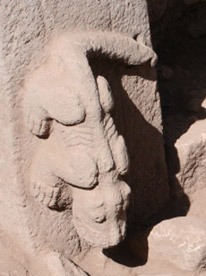
Wow. Read this news story. Archaeologists are excavating the world's oldest temple - built in 10,000 BC! That's 8,000 years before Stonehenge and some four thousand years older than the entire world (if 'young earth creationists' are to be believed).

But the thing that really intrigues me is that the temple appears to tell the 'Garden of Eden' story in sculpture form - is the carving on the right really a representation of the 'serpent' before it was cursed and lost its limbs?

I know that some biblical scholars are pretty convinced that the Garden of Eden story (Genesis 2v8 - 3v24) is the oldest story in the bible (some say at least a thousand years older than the creation story in Genesis 1), but here we appear to have it about 6,000 years earlier than I thought it was supposed to be. Wow.

Labels: ,

Wednesday, November 15, 2006

'Unbelievable' (but sadly very believable) news story


Read this story about a man who tried to use the 'multicultural' room, set apart in his workplace for religious purposes, for non-Muslim purposes.

http://www.secularism.org.uk/theextraordinarycaseofthepaganan.html

It should be unbelievable, but actually it is totally believable.

All religions are equal (in law), but it seems some are more equal than others.

And the picture of Odin on the right is relevant... honest.

Labels: